

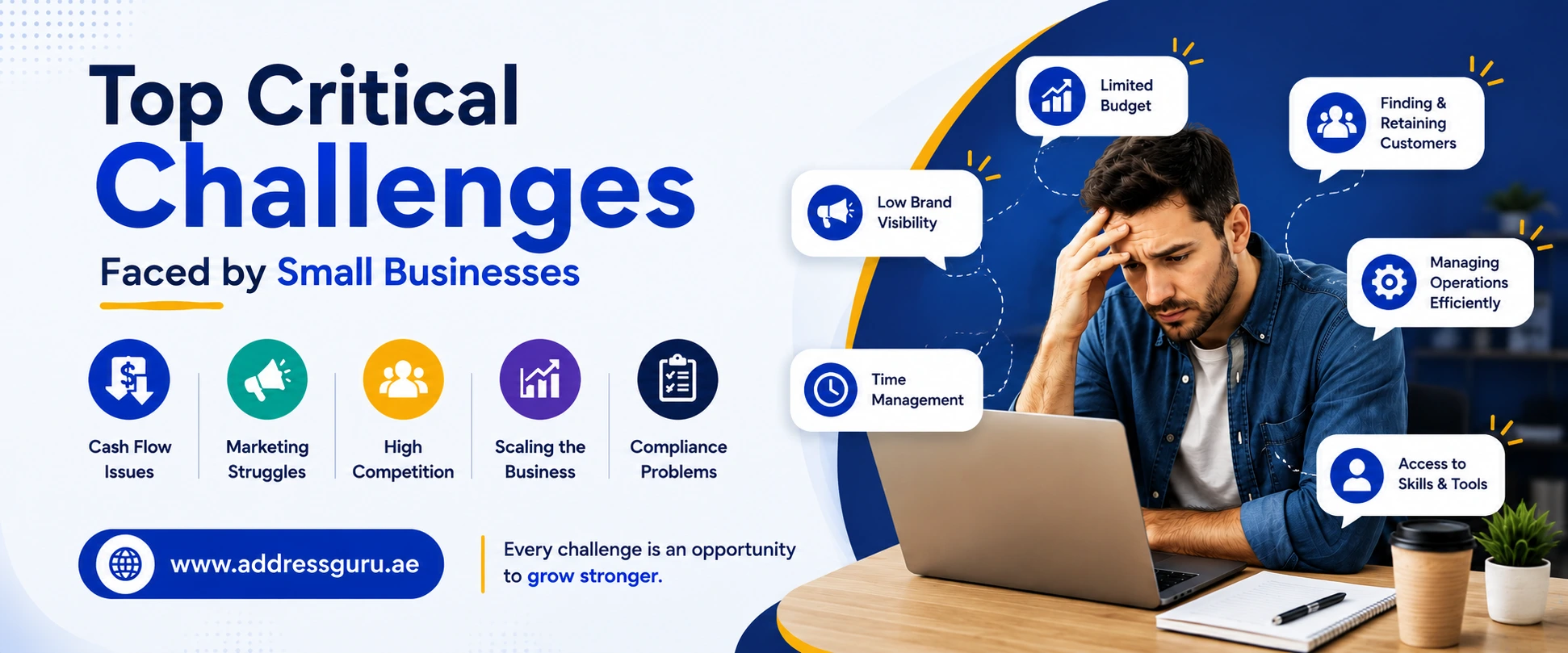
The UAE is one of the easiest places in the world to start a company, but staying profitable once the doors are open is a different story entirely. Tax-free personal income, world-class infrastructure, and a strategic location between Europe, Asia, and Africa keep pulling entrepreneurs toward Dubai, Abu Dhabi, and Sharjah every single year.
Yet behind the glossy skyline and the steady stream of new business licenses, there's a quieter reality that doesn't always make it into the brochures. Understanding the top challenges faced by small businesses in UAE is essential before you sign a lease or hire your first employee, because the gap between opening a business and running a sustainable one is wider than most newcomers expect.
This guide walks through the real obstacles small business owners run into across the Emirates, what's actually changed in recent years, and what still genuinely trips people up.
High Operational Costs Eat Into Thin Margins
Rent, utilities, and day-to-day overhead in the UAE run noticeably higher than in many comparable markets, and this hits small operators far harder than it hits large corporations with deeper pockets.
A modest retail unit or small office in a prime Dubai location can carry an annual lease cost that would feel unthinkable for a business of the same size elsewhere.
| Cost Category | Why It Adds Up |
|---|---|
| Commercial rent | Prime locations command premium rates even for small spaces |
| Utilities | Air conditioning costs run high for most of the year |
| License renewals | Annual fees apply regardless of how the year actually performed |
| Insurance and compliance | Mandatory coverage and audits add recurring expense |
The businesses that manage this well tend to negotiate lease terms carefully, choose locations based on genuine foot traffic rather than prestige alone, and build these costs into pricing from day one instead of discovering the squeeze six months in.
Why So Many Small Businesses Struggle Despite a Strong Economy
The UAE economy is genuinely strong, with steady GDP growth, a business-friendly government, and constant investment in infrastructure. So why do so many small and medium enterprises still struggle to survive their first few years?
The answer usually comes down to cost structure rather than demand. Customers exist, opportunity exists, but the cost of operating, even at a small scale, is higher here than in many comparable markets.
| Factor | Impact on Small Businesses |
|---|---|
| Office rent | Significant fixed monthly cost, even for tiny spaces |
| Visa and labour costs | Sponsorship fees add up quickly per employee |
| Licensing and renewal fees | Recurring annual expense regardless of revenue |
| High cost of living | Pushes up salary expectations across every role |

Small businesses operate on thinner margins than large corporations, which means every one of these fixed costs hits proportionally harder. This single dynamic explains much of what follows in this guide.
Cash Flow Pressure Is the Silent Killer
Cash flow management is consistently named as one of the biggest day-to-day struggles for small business owners in the UAE. It's rarely a lack of customers that sinks a small company; it's the timing gap between paying suppliers, staff, and rent while waiting on client payments that often arrive late.
Late payments from clients, especially in industries like construction, retail, and B2B services, can leave a small business stretched thin even when its order book looks healthy on paper. A few practical habits help close this gap:
- Set clear payment terms upfront and enforce them consistently.
- Keep a cash reserve covering at least a few months of fixed costs.
- Use accounting software to track receivables in real time rather than at month-end.
- Follow up on overdue invoices early, before they become genuinely overdue.

Important: cash flow problems rarely announce themselves loudly. They build quietly until a single late payment forces a painful decision, which is why tracking it weekly matters far more than checking it once a month.
Navigating Tax Compliance and Regulatory Change
For years, the UAE marketed itself as a tax-free haven, and for individuals, that's still true. For businesses, the picture has shifted. Value Added Tax arrived in 2018, and corporate tax followed more recently, which means small business owners now need to budget time and money for compliance that simply didn't exist a decade ago.
| Requirement | What It Involves |
|---|---|
| VAT registration | Mandatory once taxable turnover crosses the threshold |
| VAT filing | Regular returns submitted to the Federal Tax Authority |
| Corporate tax | Applies to business profits, with exemptions for smaller taxable income |
| Record keeping | Accurate books required to support every filing |
Many small business owners underestimate how much time proper bookkeeping demands, or assume it can wait until the end of the year. This is one of the fastest ways to end up with penalties that eat directly into already tight margins. Hiring a part-time accountant or using cloud accounting software early on is consistently one of the smartest moves available to a new business.
Finding Funding Remains Genuinely Difficult
Access to funding is one of the most frequently cited challenges in the region, and it hasn't fully resolved despite the UAE's reputation as an investment hub. Banks tend to favor established businesses with a trading history, which leaves brand-new ventures stuck between strong ambition and limited options.
Common funding routes available to small businesses include:
- Traditional bank loans, though these usually require collateral and a proven track record.
- Government-backed SME funding programs, which exist but often involve a lengthy application process.
- Angel investors and venture capital, more common in tech-focused startups than traditional small businesses.
- Bootstrapping through personal savings, which remains the most common path for many first-time founders.
Entrepreneurs who plan their financing strategy before launch, rather than scrambling once cash gets tight, tend to weather this challenge far better than those who assume capital will simply appear when needed. The businesses that secure funding earliest are almost always the ones that started looking before they actually needed it.
Intense Competition Across Nearly Every Sector
The UAE's openness to international business is a double-edged advantage. It attracts customers and investment, but it also means small businesses are competing against well-funded regional players and global brands almost from day one.
A new café in Dubai isn't just competing with the café next door; it's competing with international chains that have marketing budgets a small operator could never match.
Standing out requires more than a good product. Local businesses that succeed tend to lean into things larger competitors struggle to replicate: personalized service, niche specialization, and genuine community relationships.

A small business in UAE that tries to compete purely on price against a multinational will usually lose that fight; competing on relevance and experience is a far stronger long-term strategy. Specializing narrowly, rather than trying to appeal to everyone, often gives a small operator a fighting chance against bigger names with broader but shallower appeal.
Hiring and Retaining the Right Talent
The UAE's labour market is unusual in that the vast majority of the workforce is made up of expatriates, which creates both opportunity and friction. Visa sponsorship costs, work permit processing, and constant competition for skilled employees all add real overhead for small businesses trying to build a stable team.
Unlike a large corporation that can absorb the cost of a failed hire, a small operation often feels the impact of a single bad fit for months afterward.
| Hiring Challenge | Why It Happens |
|---|---|
| High salary expectations | Cost of living pushes up what skilled staff expect to earn |
| Visa and sponsorship costs | Each hire adds a recurring administrative expense |
| Talent competition | Larger companies can offer benefits small businesses can't match |
| Staff turnover | Many employees move between companies for better packages |
Building a workplace culture that genuinely values people, not just competitive salaries, is often what keeps small teams loyal when bigger companies come calling with higher offers.

Flexibility, clear career growth, and a sense of being heard frequently matter more to employees than a marginally higher salary elsewhere.
Keeping Up With Digital Transformation
Customers in the UAE are highly digital, comfortable shopping online, comparing prices instantly, and expecting fast responses on WhatsApp or social media. Small businesses that haven't invested in even a basic online presence are quietly losing customers to competitors who have.
This doesn't require a massive budget. A clear website, an active Google Business Profile, and consistent social media activity cover most of what a small business genuinely needs early on.
Adapting to Cultural and Operational Norms
The UAE blends a deeply rooted local culture with an enormous expatriate population, and navigating that mix takes a bit of deliberate effort. The standard workweek runs Sunday through Thursday, business relationships are built on trust and patience rather than rushed transactions, and Arabic remains the official language even though English dominates daily business.
A small business that takes the time to understand local etiquette, respects religious observances like Ramadan in its scheduling and marketing, and builds genuine relationships rather than transactional ones tends to integrate far more smoothly than one that treats the market as identical to wherever the founder came from.
Common Mistakes That Make These Challenges Worse
| Mistake | Why It Hurts | Simple Fix |
|---|---|---|
| Ignoring cash flow until it's a crisis | Leads to missed payroll or supplier payments | Track receivables weekly, not monthly |
| Delaying tax compliance setup | Risks penalties that damage already thin margins | Set up proper bookkeeping from day one |
| Underestimating capital needs | Forces rushed, expensive financing later | Plan a financing strategy before launch |
| Competing only on price | Unsustainable against larger, better-funded rivals | Focus on niche value and service quality |
| Skipping digital presence | Loses customers to more visible competitors | Build a basic website and profile early |
Final Thoughts
The top challenges faced by small businesses in UAE aren't reasons to avoid the market; they're simply the realistic cost of operating in one of the world's most ambitious and fast-moving economies. Cash flow pressure, tax compliance, limited financing, intense competition, talent retention, and the push toward digital visibility all demand real attention, but none of them are unsolvable.
The small businesses that survive and eventually thrive tend to share one trait: they plan for these obstacles before they appear, rather than reacting once the damage is already done.
Researching this topic before launch already puts a founder a step ahead of most first-time entrepreneurs, simply because awareness changes how decisions get made early on. With careful financial discipline, a clear digital strategy, and genuine respect for the local market, a small business in the UAE has every reason to grow into something lasting.